


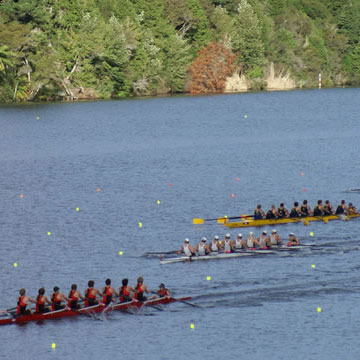
 Racing on a lake
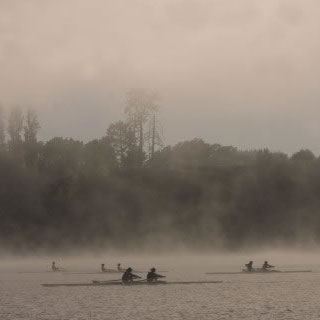
Racing in the mist
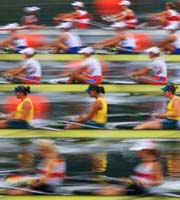
The start


Dorney Lake is located around 25 miles east of London in the ground sof Eton College. This is already a world class rowing facility that successfully hosted the 2006 Rowing World Championships. For the Olympics, a tower will be added at the finishing line along with improved warmup facilities. The venue will hold 30,000 spectators
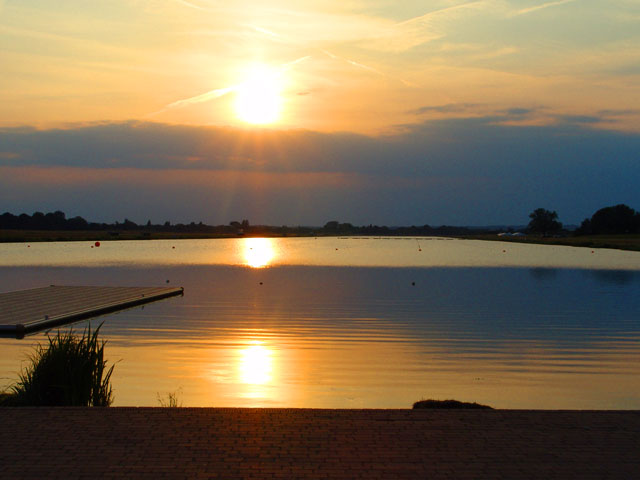
Looking down the course towards the finish
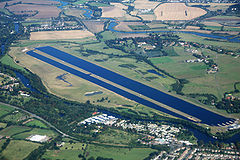
The rowing and canoeing course
Tickets are going on sale on March 15th and the Schedule of Events is available to view now! This gives you a month to decide which events to attend, which you can or can't afford and it gives an overall view Olympic Rowing.
The ODA's work is underpinned by six priority themes: design and accessibility, employment and skills, equality and inclusion, health, safety and security, sustainability and legacy.
The ODA has its headquarters in Canary Wharf, together with the London 2012 Organising Committee of the Olympic Games and Paralympic Games (LOCOG). It is led by John Armitt (Chairman) and David Higgins (Chief Executive). A delivery partner has been appointed to work with the ODA to project manage the venues and infrastructure programme for the Games. The ODA is also responsible for:
The Olympic Delivery Authority (ODA) is the public body responsible for developing and building the new venues and infrastructure for the Games and their use after 2012.
One of the key responsibilities of the ODA is building the Olympic Park, where much of the action in 2012 will take place.
The ODA's work is underpinned by six priority themes: design and accessibility, employment and skills, equality and inclusion, health, safety and security, sustainability and legacy.
The ODA has its headquarters in Canary Wharf, together with the London 2012 Organising Committee of the Olympic Games and Paralympic Games (LOCOG). It is led by John Armitt (Chairman) and David Higgins (Chief Executive). A delivery partner has been appointed to work with the ODA to project manage the venues and infrastructure programme for the Games. The ODA is also responsible for:
- Building new permanent venues
- Building arenas that will be relocated after the Games: Water Polo, Hockey, Basketball Arena, Paralympic Tennis and Archery, Greenwich Arena and the indoor Shooting hall
- Permanent works to existing sports venues, likeEton Dorney and Weymouth and Portland
- Planning and delivery on both transport infrastructure and services to support the 2012 Games projects
- Converting the Olympic Park for long-term use after the Games
- Making sure the project sets new standards for sustainable development.
The ODA is planning Games-time and long-term use together to make sure the area will be regenerated, leaving housing, schools and health facilities for the local community after 2012 alongside world class sports facilities.
Rowing Facts
There are two types of Rowing at the Olympic Games: Sweep Rowing and Sculling. Did you know? Rowing is the only sport where competitors cross the finish line backwards.Key facts
Venue: Eton Dorney
Dates: Saturday 28 July – Sunday 4 August
Gold medals up for grabs-14
Athletes- 550
Rowing- a history of the sport
Rowing is known for legendary displays of strength and stamina. The first rowing races took place on the River Thames in Shakespeare’s time, when Londoners bet on the ferries crossing between the banks. The sport developed its modern form during the 19th century, after universities adopted it as a competitive event. So began a tradition that remains to this day with the annual Boat Race between Oxford and Cambridge university students. For more information on the history of the sport visit the IOC website
Rowing at the Games Rowing has been included in the programme for every modern Olympic Games, but rough seas caused the event to be cancelled at Athens 1896. Women’s races were introduced at the Montreal 1976 Games, with the first Lightweight events staged at Atlanta 1996. The introduction of Lightweight categories has led to an increase in the number of countries achieving medal success at the Games, although traditional rowing nations such as Great Britain and Germany remain strong.
How it works
There are two types of Rowing at the Olympic Games: Sweep Rowing and Sculling.
Sweep Rowers use a single oar. They compete in crews of two, four or eight – the eight is steered by a 'cox', who also gives the crew directions. Scullers have an oar in each hand, and so can compete alone, as well as in doubles and quads. There are events for both Heavyweight and Lightweight Rowers, and crews race in six lanes over a 2,000m flat-water course, usually on a lake. Speed and stamina are the keys to success – top rowers complete 40-45 strokes a minute towards the end of a race.
Information on travelling to the Venue

 Less than two years to go to the Opening Ceremony of the Paralympic Games - it's time to start thinking about what you'll be doing in 2012! The Paralympics will be an incredible spectacle showcasing inspirational elite sport. It's the second biggest sporting event in the world, so there's plenty to look forward to, and plenty to get involved with now. Find out more below, and don't forget to check the London 2012 website regularly for all the latest updates.
There will also be a video diary from a well known athlete and the experience of an international oarsman who has previously raced at Dorney – this’ll give you an idea of what to expect when you come to the World Juniors in 2011. The course is near the historic towns of Windsor & Eton, and a short distance upstream from Windsor lies Henley-on-Thames, the location of the famous Royal Regatta and the home of the River and Rowing Museum. There’s lots of information about the local area & things to do at The Royal Borough of Windsor and Maidenhead official government website. Central London is about 30 miles / 45 kilometres away and you can get there really easily by train, bus or car. The Visit London website has information on attractions, shopping, eating and getting about.

Experiencing Real Homes
Experiencing Real Homes